
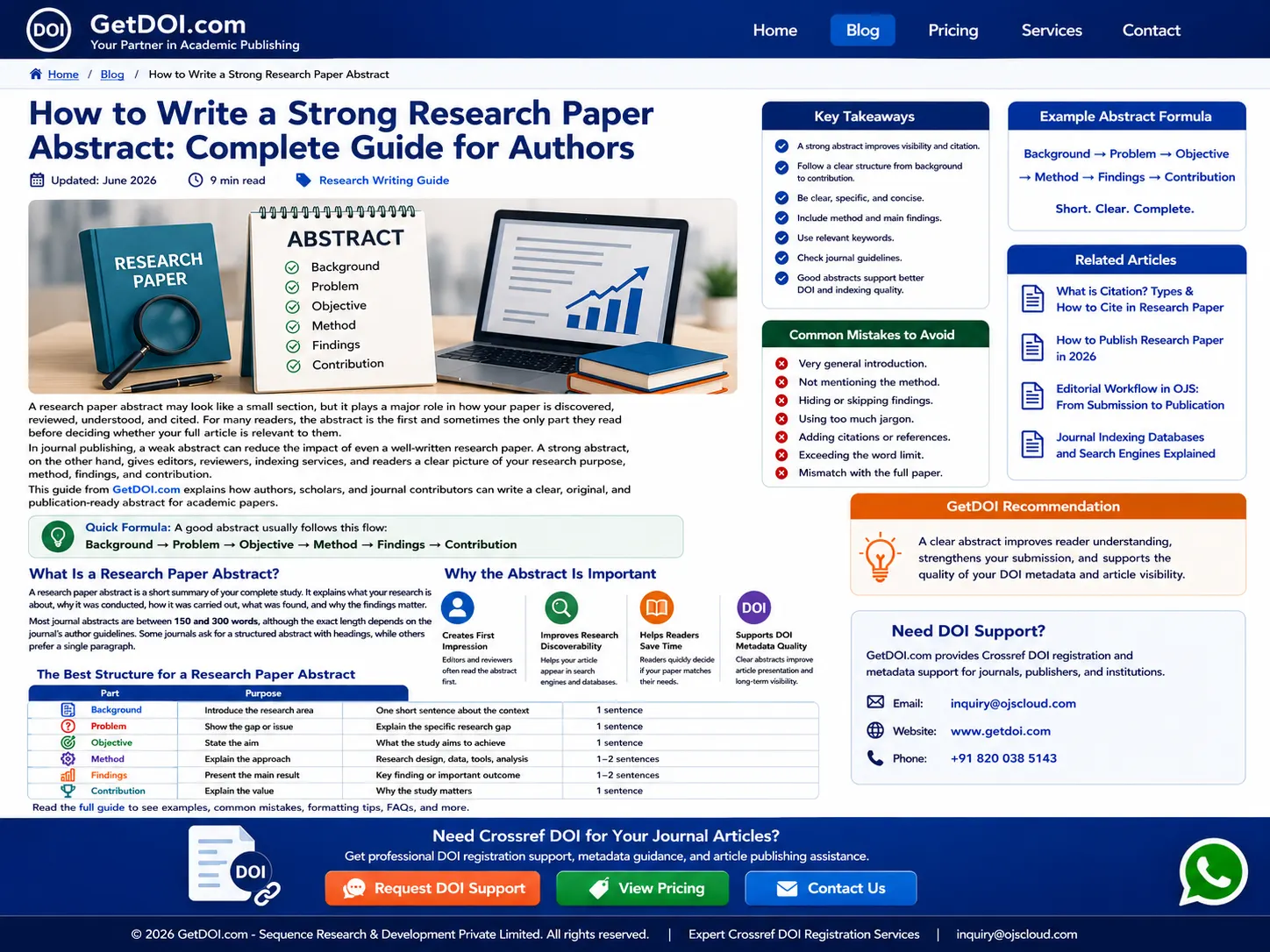
A research paper abstract may look like a small section, but it plays a major role in how your paper is discovered, reviewed, understood, and cited. For many readers, the abstract is the first and sometimes the only part they read before deciding whether your full article is relevant to them.
In journal publishing, a weak abstract can reduce the impact of even a well-written research paper. A strong abstract, on the other hand, gives editors, reviewers, indexing services, and readers a clear picture of your research purpose, method, findings, and contribution.
This guide from GetDOI.com explains how authors, scholars, and journal contributors can write a clear, original, and publication-ready abstract for academic papers.
Background → Problem → Objective → Method → Findings → Contribution
What Is a Research Paper Abstract?
A research paper abstract is a short summary of your complete study. It explains what your research is about, why it was conducted, how it was carried out, what was found, and why the findings matter.
Most journal abstracts are between 150 and 300 words, although the exact length depends on the journal’s author guidelines. Some journals ask for a structured abstract with headings, while others prefer a single paragraph.
Why the Abstract Is Important
The abstract is important because it works as the entry point to your paper. Reviewers use it to understand your study quickly. Readers use it to decide whether your article is useful. Search engines and academic databases use it to understand and display your research in search results.
1. It Creates the First Impression
Editors and reviewers often read the abstract before looking at the full manuscript. If the abstract is unclear, incomplete, or too general, it can create a poor first impression.
2. It Improves Research Discoverability
A well-written abstract with relevant keywords can help your article appear in Google Scholar, journal websites, DOI landing pages, and academic search platforms.
3. It Helps Readers Save Time
Researchers often scan many papers quickly. A clear abstract helps them understand whether your paper matches their topic, method, or citation need.
4. It Supports DOI Metadata Quality
When your article receives a DOI, its metadata becomes very important. A clear title, abstract, authorship information, publication date, and article URL help improve the quality and usefulness of the DOI record.
The Best Structure for a Research Paper Abstract
A strong abstract should be short but complete. It should not include unnecessary background, long explanations, citations, tables, or repeated statements. Use the following structure to make your abstract more effective.
1. Start with the Background
Begin with one short sentence that introduces the broader topic. This helps readers understand the field and context of your study.
Example: Digital payment adoption has increased rapidly in India, changing how consumers make daily financial decisions.
2. Identify the Research Problem
After the background, explain the specific issue, gap, or question your study addresses. Avoid broad and vague statements.
Example: However, limited research has examined how digital wallet usage influences impulse spending among young consumers.
3. State the Objective
Clearly mention what your study aims to investigate, analyze, compare, or evaluate.
Example: This study aims to examine the relationship between digital wallet usage frequency and impulse buying behavior among college students.
4. Explain the Methodology
Briefly describe how the research was conducted. Mention the research design, sample size, data source, tools, or analysis method if relevant.
Example: Data were collected through a structured questionnaire from 300 students and analyzed using correlation and regression techniques.
5. Summarize the Main Findings
This is one of the most important parts of the abstract. Do not only say that results are discussed in the paper. Give the actual key finding in brief.
Example: The findings indicate a positive relationship between frequent digital wallet usage and unplanned online purchases.
6. End with the Contribution
Conclude by explaining why your findings matter. Mention the academic, practical, policy, or industry relevance of your study.
Example: The study provides useful insights for consumer behavior researchers, fintech companies, and financial awareness programs.
Abstract Writing Formula
| Abstract Part | Purpose | Recommended Length |
|---|---|---|
| Background | Introduce the research area | 1 sentence |
| Problem | Show the gap or issue | 1 sentence |
| Objective | State the aim of the study | 1 sentence |
| Method | Explain how the study was conducted | 1–2 sentences |
| Findings | Present the main result | 1–2 sentences |
| Contribution | Explain why the research matters | 1 sentence |
Example of a Strong Research Paper Abstract
Digital payment platforms have changed consumer spending behavior by making transactions faster and more convenient. However, the influence of digital wallet usage on impulse buying among young consumers remains underexplored. This study examines the relationship between digital wallet usage frequency and impulse purchasing behavior among college students in urban India. Data were collected from 300 respondents through a structured questionnaire and analyzed using correlation and regression methods. The findings show that frequent digital wallet usage is positively associated with unplanned online purchases, especially in categories such as food delivery, fashion, and entertainment. The study contributes to consumer behavior literature and offers practical insights for fintech platforms, marketers, and financial literacy initiatives.
Common Mistakes to Avoid While Writing an Abstract
1. Writing a Very General Introduction
Avoid opening your abstract with broad statements that do not directly connect to your study. Your first sentence should quickly guide the reader toward your research topic.
2. Not Mentioning the Research Method
Many authors explain the topic but forget to mention how the study was conducted. Reviewers usually expect at least a brief method description.
3. Hiding the Findings
Do not write only “the results are discussed in the paper.” The abstract should include the actual main finding.
4. Using Too Much Jargon
Academic writing should be professional, but it should also be readable. Avoid unnecessary technical words when simple language can explain the point clearly.
5. Adding Citations
Most journal abstracts do not include references or citations. Keep the abstract focused on your own research.
6. Exceeding the Word Limit
Always check the journal’s author guidelines. If the journal asks for a 250-word abstract, do not submit 400 words.
Structured vs Unstructured Abstract
Some journals ask for a structured abstract, while others prefer a single-paragraph abstract. Both formats are acceptable if they follow the journal’s instructions.
| Type | Format | Best For |
|---|---|---|
| Structured Abstract | Uses headings like Background, Objective, Methods, Results, Conclusion | Medical, scientific, technical, and systematic studies |
| Unstructured Abstract | Written as one paragraph without headings | Humanities, management, social science, and general research papers |
How to Add Keywords After the Abstract
Keywords help readers and search systems understand the main topics of your paper. Most journals ask authors to provide 4 to 8 keywords after the abstract.
Choose keywords that are specific, searchable, and directly connected to your research. Avoid very broad words such as “education,” “technology,” or “science” unless they are combined with a more specific term.
Example Keywords
- Digital wallet adoption
- Impulse buying behavior
- Consumer psychology
- Fintech usage
- Online spending pattern
Checklist Before Submitting Your Abstract
- Does the abstract clearly explain the topic?
- Does it mention the research problem?
- Does it state the objective of the study?
- Does it describe the method briefly?
- Does it include the main finding?
- Does it explain the contribution?
- Is it within the journal’s word limit?
- Are the keywords relevant and searchable?
- Is the language clear and original?
- Does the abstract match the full paper?
How a Good Abstract Supports DOI and Indexing
A DOI gives your research article a permanent digital identity. But for a DOI record to be useful, the article metadata should be accurate and complete. This includes the title, author details, publication year, journal name, article URL, and other metadata.
Although the abstract itself may not always be deposited in every DOI record, a strong abstract improves the quality of the article landing page. This helps readers understand the paper quickly and supports better academic visibility.
Final Thoughts
Writing a strong research paper abstract is not just a formatting task. It is a communication skill. A good abstract helps your research reach the right readers, supports the peer-review process, improves discoverability, and strengthens the overall presentation of your paper.
The best abstract is clear, concise, accurate, and complete. It tells readers what you studied, why it matters, how you studied it, what you found, and how your work contributes to the field.
At GetDOI.com, we help journals and publishers improve the digital identity of their research articles through DOI registration and metadata support. If your journal is planning to assign Crossref DOIs to published articles, proper article structure and metadata quality should be your first priority.
Frequently Asked Questions
How long should a research paper abstract be?
Most abstracts are between 150 and 300 words. Always follow the specific word limit given by the target journal.
Should I write the abstract before or after the paper?
It is usually better to write the abstract after completing the full paper because you will have a clearer understanding of the final findings and contribution.
Can I include references in an abstract?
In most cases, references are not included in the abstract. The abstract should summarize your own study without citations.
What is the most important part of an abstract?
The findings are very important. Many weak abstracts describe the topic but do not clearly state what the study found.
Does a DOI improve research visibility?
A DOI provides a permanent digital identifier for a research article and helps readers access the article reliably when the DOI metadata and article landing page are properly maintained.
Contact Information:
Email: inquiry@ojscloud.com
Website: www.getdoi.com
Phone: +91 820 038 5143