
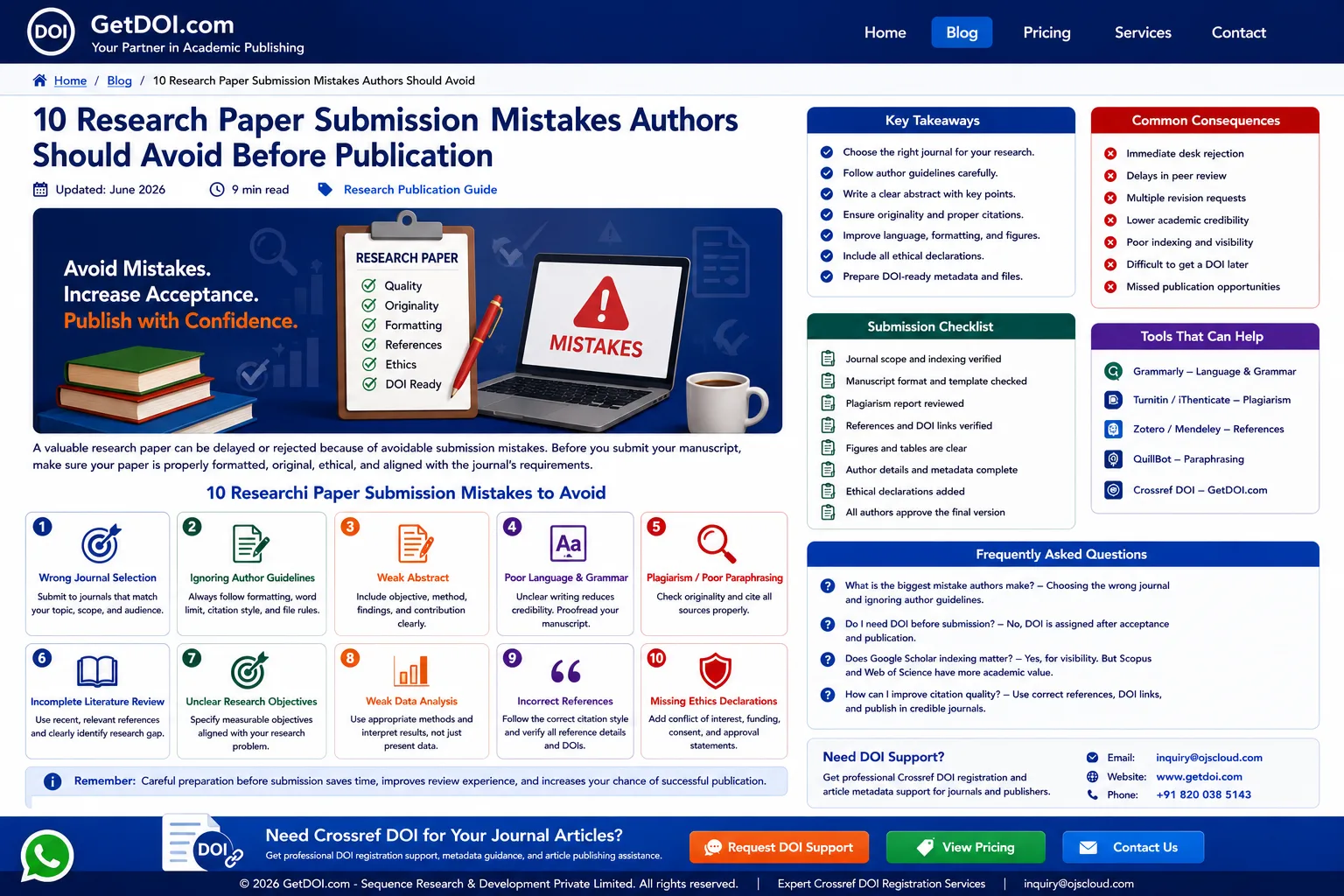
Submitting a research paper to a journal is an important step for every author, scholar, and academic researcher. But many manuscripts face delays, revision requests, or rejection because of avoidable submission mistakes. In many cases, the research idea is valuable, but the paper is not prepared according to journal expectations.
A successful publication is not only about writing good content. It also depends on journal selection, formatting, originality, references, metadata, ethical compliance, and article presentation. For journals and publishers, these same details also affect DOI readiness, indexing quality, and long-term discoverability.
This guide from GetDOI.com explains the most common mistakes authors make before submitting a research paper and how to fix them in a practical way.
Before submission, check journal scope, formatting rules, plagiarism level, abstract quality, references, figures, author details, ethical declarations, and DOI-ready metadata.
1. Choosing the Wrong Journal
One of the biggest mistakes authors make is submitting their manuscript to a journal that does not match the topic, subject area, research method, or academic level of the paper.
The Problem
If your paper is about medical science but the journal mainly publishes engineering research, your manuscript may be rejected before review. Similarly, if your study is regional or applied but the journal prefers theoretical research, the scope mismatch can create problems.
How to Fix It
- Read the journal’s aims and scope carefully.
- Check recently published articles in the same journal.
- Verify whether your topic fits the journal’s subject category.
- Avoid journals that publish every topic without a clear scope.
- Check indexing claims from official sources before submission.
2. Ignoring Author Guidelines
Every journal has its own author guidelines. These guidelines may include formatting style, word limit, citation style, figure quality, file format, abstract length, and reference format.
The Problem
Many authors submit papers in a generic format without checking the journal’s instructions. This creates extra work for editors and may delay the review process.
How to Fix It
- Download the journal template if available.
- Check title page requirements.
- Follow abstract and keyword limits.
- Use the required citation style.
- Prepare tables and figures as per journal standards.
3. Weak Abstract
The abstract is the first section editors, reviewers, and readers see. A weak abstract can make even a good paper look unclear.
The Problem
Some abstracts only introduce the topic but do not mention the research objective, methodology, findings, or contribution. Others are too long, too technical, or too general.
How to Fix It
Write your abstract after completing the paper. A strong abstract should briefly explain:
- Background of the study
- Research problem
- Main objective
- Methodology
- Key findings
- Contribution or significance
Background → Problem → Objective → Method → Result → Contribution
4. Poor Language and Grammar
Academic writing should be clear, professional, and easy to understand. Poor grammar, spelling mistakes, and unclear sentence structure can reduce the credibility of your manuscript.
The Problem
Reviewers may struggle to understand the research if the language is confusing. In some cases, poor writing can lead to rejection even when the research topic is useful.
How to Fix It
- Proofread the manuscript multiple times.
- Ask a colleague or mentor to review the paper.
- Use grammar checking tools carefully.
- Avoid unnecessary jargon.
- Keep sentences short and clear.
5. Plagiarism or Poor Paraphrasing
Originality is one of the most important requirements in academic publishing. Plagiarism can damage the author’s reputation and lead to rejection.
The Problem
Plagiarism does not always happen intentionally. It may occur because of copied definitions, poor paraphrasing, missing citations, reused text from previous work, or improper use of online sources.
How to Fix It
- Run a plagiarism check before submission.
- Cite all borrowed ideas and data.
- Use your own explanation instead of copying text.
- Avoid excessive self-plagiarism from your previous papers.
- Follow the journal’s plagiarism policy.
6. Incomplete Literature Review
A literature review explains what has already been studied and where your research fits. Without a proper literature review, your paper may look disconnected from existing knowledge.
The Problem
Many authors cite only a few sources or include outdated references. Some papers do not clearly explain the research gap.
How to Fix It
- Review recent papers from the last 5 years where possible.
- Include foundational studies where required.
- Compare different viewpoints in the field.
- Clearly mention the research gap.
- Explain how your study contributes to the subject.
7. Unclear Research Objectives
A research paper must have a clear purpose. If the objective is not clear, readers may not understand what the study is trying to prove, analyze, or explain.
The Problem
Some authors write broad objectives such as “to study the topic” or “to analyze the issue” without explaining the specific research direction.
How to Fix It
- Write specific and measurable objectives.
- Connect objectives with the research problem.
- Do not add too many unrelated objectives.
- Make sure the conclusion answers the objectives.
8. Weak Data Analysis
Data alone does not make a strong research paper. Authors must explain what the data means and how it supports the research objective.
The Problem
Some papers only present tables, charts, or percentages without interpretation. Reviewers expect analysis, not just raw numbers.
How to Fix It
- Use appropriate analysis methods.
- Explain why the selected method is suitable.
- Interpret every important table or figure.
- Connect findings with the research objectives.
- Avoid unsupported claims.
9. Incorrect References and Citation Style
References are not only a formality. They show the academic foundation of your paper and help readers verify your sources.
The Problem
Common issues include missing references, inconsistent citation style, incorrect author names, broken URLs, missing DOI links, and references cited in the text but not listed at the end.
How to Fix It
- Use a reference manager such as Zotero, Mendeley, or EndNote.
- Follow the journal’s required style.
- Check every in-text citation against the reference list.
- Add DOI links where available.
- Verify author names, journal names, volume, issue, and page numbers.
10. Missing Publication Ethics Declarations
Many journals require authors to submit ethical declarations along with the manuscript. These may include conflict of interest, funding details, data availability, consent, and author contribution statements.
The Problem
If declarations are missing, editors may send the paper back before review. This delays the publication process.
How to Fix It
- Add a conflict of interest statement.
- Mention funding details if applicable.
- Include ethics approval for studies involving humans or animals.
- Add consent statements where required.
- Confirm that all authors have approved the final manuscript.
Submission Checklist for Authors
| Check Point | What to Verify | Status |
|---|---|---|
| Journal Scope | Paper topic matches journal subject area | Before submission |
| Formatting | Template, font, headings, spacing, tables, figures | Before upload |
| Abstract | Objective, method, findings, contribution included | Before final draft |
| Originality | Plagiarism checked and citations added | Before submission |
| References | Citation style followed and DOI links checked | Before final PDF |
| Ethics | Funding, conflict, consent, approval statements added | Before submission |
How DOI Readiness Helps After Acceptance
Once a paper is accepted and published, a DOI helps provide a permanent digital identity for the article. But DOI registration works best when article metadata is clean and complete.
Authors and journal publishers should make sure the final article has a proper title, author names, affiliations, abstract, keywords, references, PDF link, publication date, and stable article URL.
A professional article page with complete metadata, DOI link, citation format, and accessible PDF improves trust, discoverability, and reader experience.
Final Thoughts
Research paper submission is not just about uploading a manuscript. It is a complete preparation process. Authors must make sure their paper is original, well-formatted, properly referenced, ethically prepared, and aligned with the journal’s scope.
Avoiding these common mistakes can save time, reduce revision delays, and improve your chance of successful publication. For journals and publishers, maintaining strong submission standards also improves credibility and indexing readiness.
At GetDOI.com, we help journals and publishers improve article-level visibility through DOI registration and metadata support. A well-prepared article is easier to publish, easier to cite, and easier to preserve.
Frequently Asked Questions
What is the most common mistake in research paper submission?
The most common mistake is not following the journal’s author guidelines. Formatting, reference style, abstract length, and file requirements should always be checked before submission.
Can plagiarism lead to rejection?
Yes. High similarity, copied content, poor paraphrasing, or missing citations can lead to rejection. Authors should check originality before submission.
Does DOI mean the paper is indexed?
No. DOI and indexing are different. A DOI gives the article a permanent identifier, while indexing depends on whether the journal or article is included in a database.
Should references include DOI links?
Where available, DOI links should be included according to the journal’s citation style. DOI links make references easier to verify and access.
How can publishers improve article metadata?
Publishers should maintain clean article pages with title, authors, affiliations, abstract, keywords, references, publication date, PDF, citation format, and DOI link.
Contact Information:
Email: inquiry@ojscloud.com
Website: www.getdoi.com
Phone: +91 820 038 5143