
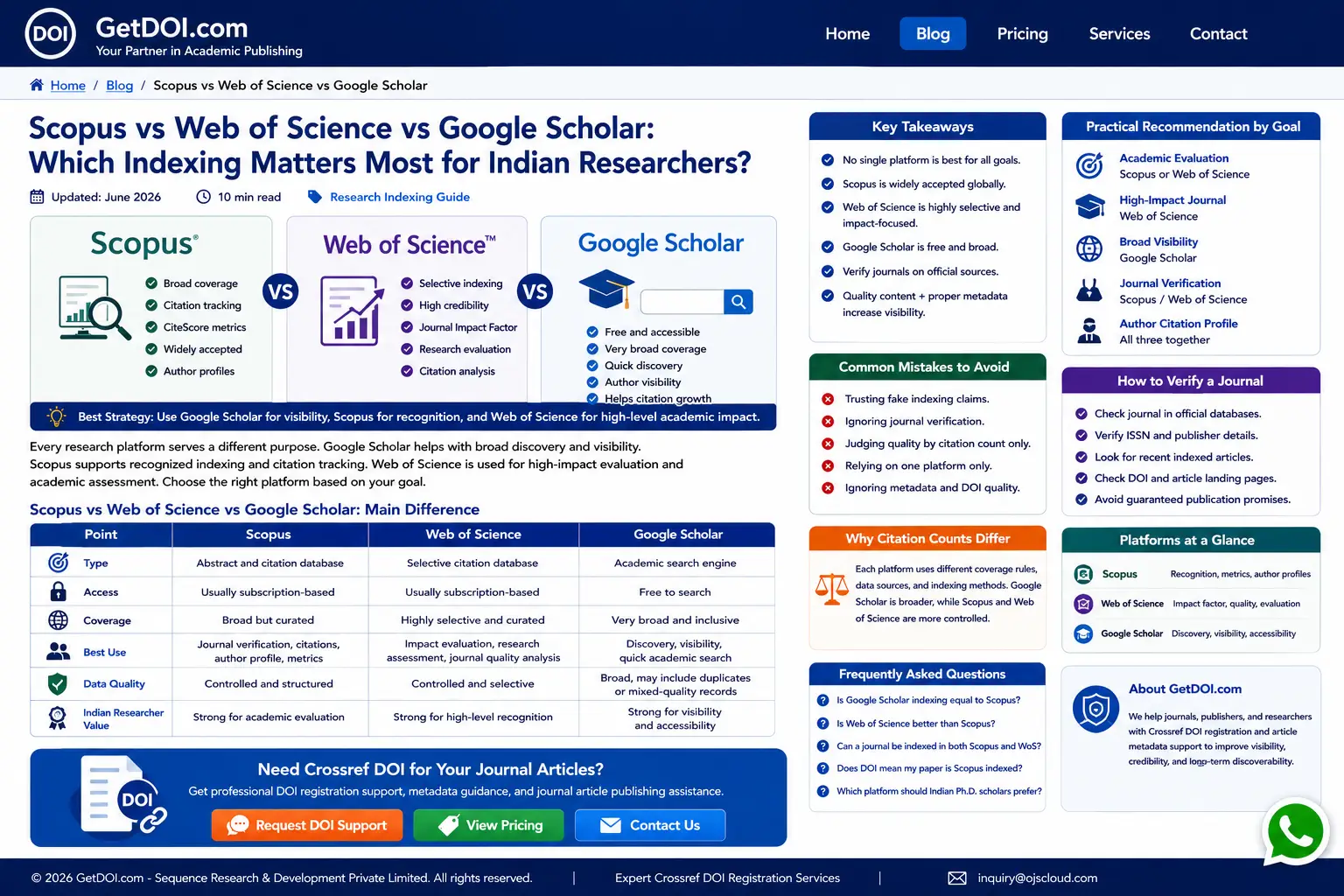
For Indian researchers, choosing the right journal is no longer only about publication. It is about visibility, academic credibility, citation impact, institutional evaluation, promotion, research grants, and long-term discoverability. This is why names like Scopus, Web of Science, and Google Scholar are often discussed before submitting a research paper.
However, many authors get confused because all three platforms are related to academic discovery, but they do not work in the same way. Scopus and Web of Science are selective citation databases. Google Scholar is a broad academic search engine. Each has a different purpose, different coverage, and different value for researchers.
This guide from GetDOI.com explains the difference between Scopus, Web of Science, and Google Scholar in simple language, especially for Indian researchers, Ph.D. scholars, faculty members, journal editors, and academic publishers.
Use Google Scholar for broad discovery and visibility. Use Scopus for recognized indexing and citation tracking. Use Web of Science for highly selective indexing, impact factor, and formal academic evaluation.
What Is Academic Indexing?
Academic indexing means a journal, article, or research record is included in a recognized database or search platform. Indexing helps researchers find published work and also helps institutions evaluate research quality and visibility.
A journal that is indexed in a trusted database usually receives more attention because its published articles become easier to discover, track, and cite. For authors, indexed journals often carry more academic value than non-indexed journals.
What Is Scopus?
Scopus is a large abstract and citation database widely used by universities, researchers, and institutions. It covers peer-reviewed journals, conference proceedings, books, and other scholarly records across many disciplines.
For Indian researchers, Scopus is important because many universities, promotion committees, research guides, and academic bodies consider Scopus-indexed publications as valuable for academic records.
Why Scopus Matters
- It is widely accepted for academic evaluation.
- It provides citation tracking and author profiles.
- It includes journal-level indicators like CiteScore.
- It helps researchers find credible journals in their subject area.
- It is commonly used for research performance analysis.
What Is Web of Science?
Web of Science is a selective citation database known for its curated journal coverage. It is commonly associated with high-quality indexing, citation analysis, and Journal Citation Reports.
Many researchers connect Web of Science with journals having Journal Impact Factor, although not every Web of Science indexed journal has the same category, value, or evaluation status. Authors should carefully check the exact index and journal profile before making a publication decision.
Why Web of Science Matters
- It is highly respected for formal academic evaluation.
- It is used for citation analysis and research assessment.
- It connects with Journal Citation Reports and impact-related indicators.
- It has selective journal inclusion standards.
- It is useful for researchers aiming for high-recognition publication records.
What Is Google Scholar?
Google Scholar is a freely accessible academic search platform. It helps users find scholarly literature such as journal articles, theses, books, conference papers, preprints, reports, and institutional repository content.
Unlike Scopus and Web of Science, Google Scholar is broader and more inclusive. It is useful for visibility because many students, researchers, and general readers use it to search academic material quickly.
Why Google Scholar Matters
- It is free and easy to access.
- It helps articles appear in academic search results.
- It often covers a wider range of scholarly content.
- It is useful for author profiles and citation visibility.
- It supports discovery for regional and open-access content.
Scopus vs Web of Science vs Google Scholar: Main Difference
| Point | Scopus | Web of Science | Google Scholar |
|---|---|---|---|
| Type | Abstract and citation database | Selective citation database | Academic search engine |
| Access | Usually subscription-based | Usually subscription-based | Free to search |
| Coverage | Broad but curated | Highly selective and curated | Very broad and inclusive |
| Best Use | Journal verification, citations, author profile, metrics | Impact evaluation, research assessment, journal quality analysis | Discovery, visibility, quick academic search |
| Data Quality | Controlled and structured | Controlled and selective | Broad but may include duplicates or mixed-quality records |
| Indian Researcher Value | Strong for academic evaluation | Strong for high-level recognition | Strong for visibility and accessibility |
Which Indexing Is Best for Indian Researchers?
There is no single answer for every researcher. The best indexing platform depends on your academic goal. A Ph.D. scholar, faculty member, medical researcher, engineering professor, social science author, and journal publisher may all have different needs.
For Ph.D. Scholars
Ph.D. scholars should first check their university guidelines. Some universities prefer Scopus or Web of Science publications, while some also accept journals listed in recognized national or subject-specific databases. Google Scholar visibility is useful, but it may not be enough for formal academic requirements.
For Faculty Promotions
Faculty members should focus on journals accepted by their institution, university, or evaluation body. Scopus and Web of Science usually carry higher formal value because they are structured citation databases.
For Citation Growth
Google Scholar can help increase visibility because it is widely used and freely accessible. However, citation counts may vary across platforms. Scopus and Web of Science provide more controlled citation records.
For International Recognition
Web of Science and Scopus indexed publications are often preferred when researchers want international recognition, collaboration opportunities, and stronger academic profiles.
For Regional or Interdisciplinary Research
Google Scholar can be helpful for regional topics, interdisciplinary work, conference papers, theses, and open-access content because it searches broadly across the web.
Practical Recommendation by Goal
| Your Goal | Best Platform | Reason |
|---|---|---|
| Formal academic evaluation | Scopus or Web of Science | These are structured and widely recognized citation databases. |
| High-impact journal publication | Web of Science | Often linked with selective journal evaluation and impact-related indicators. |
| Broad article visibility | Google Scholar | It is free and widely used by researchers and students. |
| Journal verification | Scopus / Web of Science official databases | Helps avoid fake indexing claims and cloned journals. |
| Author citation profile | All three together | Each platform may show different citation counts and coverage. |
Why Citation Counts Differ Across Platforms
One common confusion among researchers is why the same article may show different citation counts in Google Scholar, Scopus, and Web of Science. The reason is simple: each platform uses different coverage rules, data sources, and indexing methods.
Google Scholar may show more citations because it covers a wider range of academic materials. Scopus and Web of Science may show fewer citations, but their data is usually more structured and controlled.
How to Check Whether a Journal Is Really Indexed
Fake indexing claims are a serious issue in academic publishing. Many journals display Scopus, Web of Science, UGC, Crossref, or Google Scholar logos without proper verification.
Before submitting your paper, follow these steps:
- Check the journal title and ISSN carefully.
- Search the journal in the official Scopus database or source list.
- Search the journal in the official Web of Science Master Journal List.
- Check whether recent articles are actually indexed.
- Verify the journal website and publisher details.
- Check DOI links and article landing pages.
- Avoid journals that promise guaranteed publication without proper review.
Role of DOI in Research Visibility
Indexing and DOI are different, but both are important. A DOI gives a research article a permanent digital identity. Indexing helps the article become discoverable in academic databases and search platforms.
A DOI does not automatically mean that a journal is indexed in Scopus or Web of Science. Similarly, Google Scholar visibility does not guarantee Scopus or Web of Science indexing. Authors and publishers should understand these differences clearly.
For Journal Publishers: What Should You Focus On?
If you manage a journal, your goal should not be only to display indexing logos. Your focus should be on building a transparent, trustworthy, and technically strong journal website.
- Publish clear editorial policies.
- Maintain proper peer-review workflow.
- Display article metadata clearly.
- Assign DOI properly to published articles.
- Use clean article URLs.
- Avoid duplicate or broken article pages.
- Keep archives accessible.
- Follow publication ethics and plagiarism policies.
Strong publishing practices improve your chances of long-term credibility and indexing readiness.
Final Verdict: Which One Matters Most?
For Indian researchers, the most useful approach is not to depend on only one platform. Each database serves a different purpose.
- Use Google Scholar for discoverability, citation visibility, and broad academic search.
- Use Scopus for recognized publication records, journal verification, and citation tracking.
- Use Web of Science for high-level research evaluation, selective indexing, and impact-related recognition.
If your goal is formal academic evaluation, Scopus and Web of Science usually matter more. If your goal is broad visibility and easy access, Google Scholar is extremely useful. If your goal is long-term credibility, focus on publishing in ethical journals with proper DOI, clean metadata, peer review, and transparent editorial practices.
Do not choose between visibility and credibility. Aim for both. Publish in ethical journals, verify indexing claims, maintain proper DOI records, and make sure your article pages are clean, complete, and discoverable.
Frequently Asked Questions
Is Google Scholar indexing equal to Scopus indexing?
No. Google Scholar is a broad academic search engine, while Scopus is a structured citation database. Google Scholar visibility is useful, but it is not the same as Scopus indexing.
Is Web of Science better than Scopus?
Both are respected databases. Web of Science is often considered more selective, while Scopus has broad subject coverage. The better option depends on your subject, institution, and academic goal.
Can a journal be indexed in both Scopus and Web of Science?
Yes. Some journals are indexed in both databases. Authors should verify the journal using official databases before submission.
Does DOI mean my paper is Scopus indexed?
No. DOI and Scopus indexing are different. A DOI gives your article a permanent identifier, but Scopus indexing depends on whether the journal and article are included in Scopus.
Which platform should Indian Ph.D. scholars prefer?
Ph.D. scholars should follow their university guidelines. In many cases, Scopus and Web of Science publications carry stronger formal value, while Google Scholar helps with visibility.
Contact Information:
Email: inquiry@ojscloud.com
Website: www.getdoi.com
Phone: +91 820 038 5143